Knut Hamsun in Tromsø
Updated: Jul 15
October, 2015

Starting a blog has always been in the back of my mind, but I never found a proper reason to have one. Almost every book I ended up reading—including those I couldn’t finish—has gifted me, one way or another, with a story. So, I thought it will be these stories that I'll share on this blog.
I remember my first encounter with Knut Hamsun in Tromsø in late October 2015. Before leaving Dubai, I’d read somewhere that Tromsø is the capital of the Arctic and that temperatures were already well below zero by October. When the plane landed, I was zipped up to my chin, warm boots on, scarf wrapped tight, gloves ready—I was fully prepared. But I still vividly recall how dumbfounded I stood waiting for a taxi outside the airport, watching people running, cycling, and leisurely strolling along the strait, some are wearing long sleeves, some in short sleeves. It was 23°C degrees to them, -4°C to me.
When we reached the hotel and paid my fare, the driver leaned over before handing me the change. “First time here?”
I nodded. He gave me roughly twelve dollars back, and with a warm smile, he said, “Coffee change.”
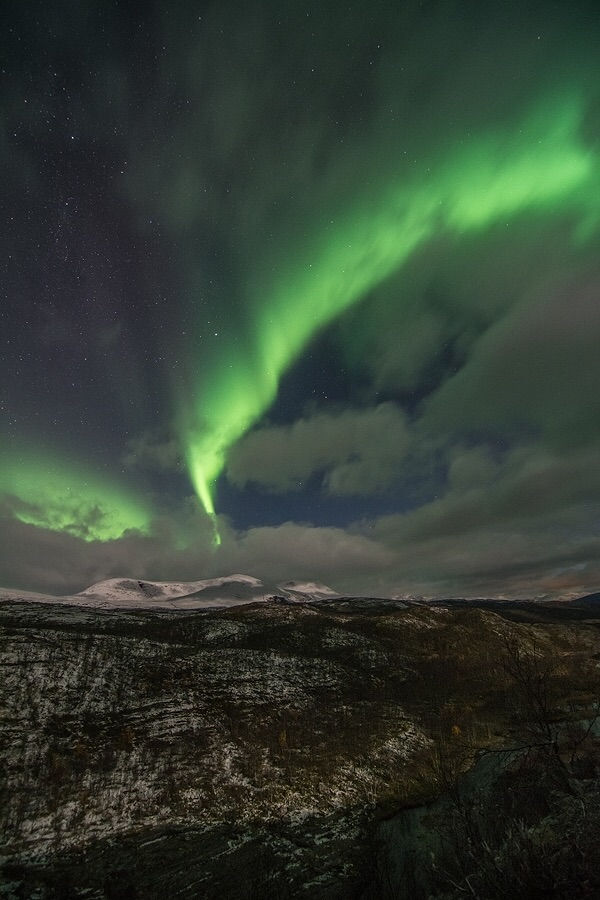
At 11 p.m., my phone blinked. There is a message. I had traveled all the way to Tromsø for aurora hunting, having booked a local tour earlier that week, and now my guide was waiting in a blue van outside the hotel. We were only two in the group: me and a young man from India named Vivek. Our guide, Nick, explained that cloud cover made for poor viewing conditions and noted that October isn’t peak season—hence the small group. But he was determined to give us the experience anyway. His plan was to drive toward the Finnish border, where aurora activity tended to be stronger.
So there we were in Finland hours later, Nick navigating by a GPS that tracked aurora forecasts. He told us we were in range and soon the lights will show up. He stopped the van, and got a small fire going. We sat on foldable chairs, surrounded by an overwhelming swell of darkness with cold earth beneath our boots, waiting. Nick had come well prepared, bringing spicy vegetable soup and thick slices of sourdough bread. There was something about the whole scene that seemed to push back against the chill.
But the temperature was easily –8°C, with occasional gusts slicing through the air. I was fully bundled up, trying to hide how my bones rattled every time a cold front rolled in. Vivek sat across from me, looking like some kind of ninja, and I could tell his bones were shaking too—we both fell completely silent whenever the wind picked up. But then there was Nick. All-mighty Nick! He sat comfortably wearing a fisherman’s beanie pulled halfway over his short hair, a sweater, long track pants, and sturdy boots. No gloves.
“Don’t you feel cold, man?” I asked.
“We Norwegians never get cold,” he replied. “We just turn blue and die.”
I still remember that night. The auroras finally broke through the clouds, and the darkness felt almost inviting. We sat for another hour, chatting about this and that, sipping ginger tea, courtesy of all-mighty Nick. During our conversation, he mentioned Knut Hamsun in passing. It was simply a casual mention.
The next morning, I woke up late and headed out in search of Hamsun. I literally had nothing else to do. I figured I’d find his books in local stores—and I did—but they were all in Norwegian. After a long walk (something I never get enough of), two young men who looked like recent graduates stopped me. One was holding a small maroon book and asked if I wanted to know about Mormonism. I told him I wanted to know more about Hamsun instead. We laughed and they pointed me at the library. I’m not sure why it never occurred to me to go there before, but in the end, I didn’t go to the library either. I returned to my hotel and bought a digital copy of the first Knut Hamsun book I could find.

By nightfall, I had finished Pan. I went online again and bought The Wanderer. I spent my four days in Tromsø walking its streets and reading Hamsun. There is something archaic yet minimal about his prose. His characters don’t try to be too much. It’s clear that he has influenced generations of writers; I can find traces of him in most of the books I’ve read since. Now and again, I return to his pages just to recapture that initial sense of discovery. In a way, it’s Hamsun’s work that reminds me of those auroras, of Vivek, Nick, and Tromsø itself—not the other way around.
Unlike my random entry, I’d recommend starting with The Wanderer rather than Pan. But honestly, you won’t go wrong no matter which Hamsun book you open first. Whether you read for pleasure or to study craft, he deserves a place on your shelf. That said, I’d save Hunger for last.

The Ring is Closed, Knut Hamsun 
The Road Leads On, Knut Hamsun 
Victoria, Knut Hamsun 
Takes of Love and Loss, Knut Hamsun 
Mysteries, Knut Hamsun 
Look Back on Happiness, Knut Hamsun 
Dreamers, Knut Hamsun 
The Wanderer, Knut Hamsun 
Hunger, Knut Hamsun 
Growth of the Soil, Knut Hamsun 
Pan, Knut Hamsun
